Planning for future medical care is something many people postpone. It can be uncomfortable to consider circumstances involving serious illness, an accident, permanent incapacity, or end-of-life decisions. However, unexpected medical emergencies can happen at any age, and there may come a time when a person cannot communicate their healthcare preferences or make medical decisions independently.
A healthcare directive is an important legal planning document that helps protect an individual's right to make decisions about their medical care, even when they are no longer able to communicate those decisions.
Healthcare directives allow individuals to document their treatment preferences, appoint someone they trust to make healthcare decisions on their behalf, or do both. They can address issues such as life-sustaining treatment, artificial nutrition and hydration, pain management, and other medical interventions.
Although healthcare directives are sometimes associated exclusively with older adults or terminally ill patients, they are valuable for adults of all ages. A sudden accident, stroke, surgical complication, or unexpected illness can leave anyone temporarily or permanently unable to make healthcare decisions.
Understanding what a healthcare directive is, what it can legally contain, and what limitations apply can help individuals and families make informed decisions before a medical crisis occurs.
What is a healthcare directive?
A healthcare directive is a written legal document that communicates an individual's healthcare wishes and provides instructions about who may make medical decisions if the individual becomes unable to make or communicate those decisions.
In Minnesota, healthcare directives are governed primarily by Minnesota Statutes, Chapter 145C.
Under Minnesota Statute § 145C.02, a person with decision-making capacity may execute a healthcare directive containing healthcare instructions, a healthcare power of attorney, or both.
A healthcare directive generally serves two purposes:
Documenting healthcare preferences: It provides instructions about the medical treatments and healthcare decisions an individual would or would not want.
Appointing a healthcare agent: It identifies a trusted person who may make healthcare decisions when the individual lacks decision-making capacity, subject to the authority granted in the document.
A healthcare directive can contain one or both of these components. An individual does not necessarily have to appoint an agent if they prefer to provide written healthcare instructions without doing so.
Different Types of Healthcare Planning Documents
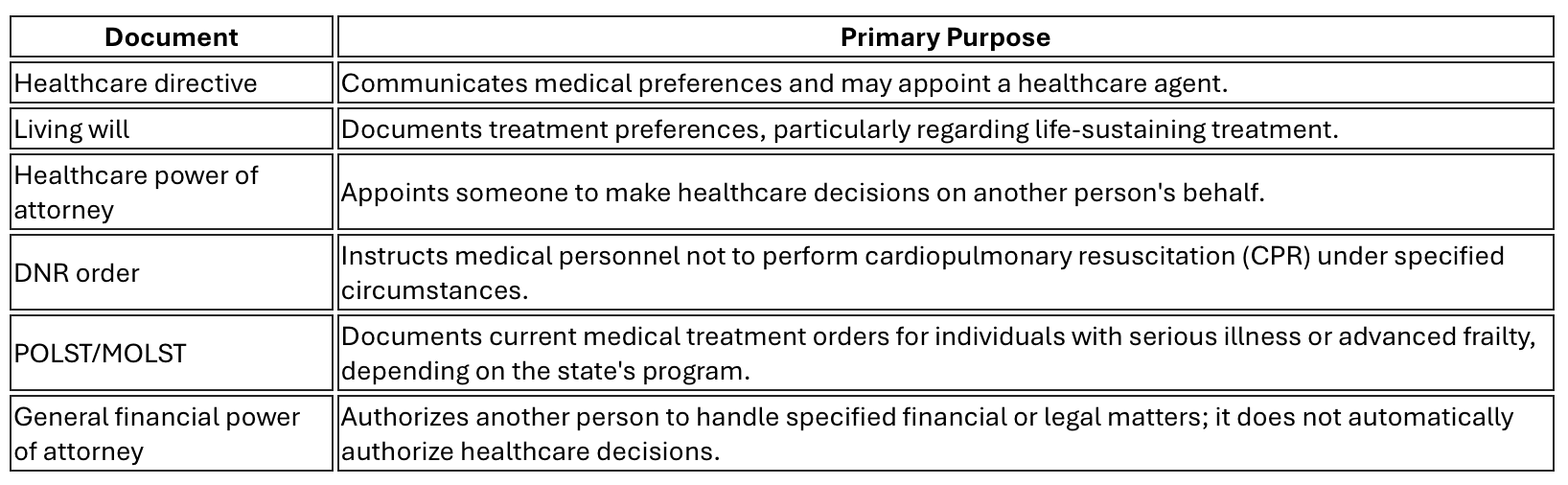
In Minnesota, many provisions traditionally associated with a living will and healthcare power of attorney can be combined into one healthcare directive.
It is important not to confuse an advance healthcare directive with a DNR order or POLST form. A healthcare directive communicates future preferences and may appoint an agent. A DNR is a medical order concerning CPR, while a POLST is designed to communicate current treatment orders for qualifying patients.
These documents can complement one another, but they are not interchangeable.
What to include in a healthcare directive
One of the most important features of a healthcare directive is the flexibility it provides.
Minnesota law allows individuals to include healthcare instructions consistent with applicable law. Individuals can be as specific or as general as they wish when describing their healthcare preferences.
Under Minnesota Statute § 145C.05, provisions may include the appointment of alternate agents, instructions for joint agents, and other provisions consistent with the statute.
Examples of information that may be included are outlined below:
A. Appointment of a Healthcare Agent
A healthcare directive can identify a trusted individual to make medical decisions if the person who created the directive becomes unable to make those decisions. This individual is commonly called a healthcare agent, healthcare proxy, or healthcare representative.
A healthcare agent may be authorized to:
Communicate with healthcare providers.
Review medical information and records, subject to applicable authority and limitations.
Make decisions about medical treatment.
Approve or decline certain medical procedures.
Make decisions regarding life-sustaining treatment.
Help determine appropriate care settings.
Make decisions consistent with the individual's documented wishes and applicable law.
The person selected should be trustworthy, willing to accept the responsibility, and capable of making difficult decisions under stressful circumstances.
It is advisable to discuss healthcare preferences with the proposed agent before appointing them.
B. Appointment of Alternate Healthcare Agents
Individuals may name alternate agents in case their primary agent is unavailable, unwilling, or unable to serve.
This is an important safeguard because the primary agent may be traveling, ill, unreachable, or otherwise unable to participate when a medical decision is needed.
Minnesota law also permits individuals to appoint joint healthcare agents and provide instructions about how those agents should make decisions.
C. Medical Treatment Preferences
A healthcare directive can explain which treatments an individual would want or refuse under particular circumstances.
Examples include:
Cardiopulmonary resuscitation (CPR).
Mechanical ventilation.
Dialysis.
Major surgical procedures.
Blood transfusions.
Antibiotics.
Chemotherapy.
Artificial nutrition and hydration.
Other life-sustaining treatments.
It is particularly helpful to explain the circumstances under which a treatment would or would not be desired.
For example, someone might want temporary mechanical ventilation if recovery is reasonably expected but decline prolonged life support if there is no reasonable prospect of regaining meaningful awareness.
D. Artificial Nutrition and Hydration
A healthcare directive may address whether an individual wants nutrition and hydration provided through medical means, such as feeding tubes or intravenous fluids.
These decisions can be particularly important in circumstances involving advanced illness, permanent unconsciousness, or an inability to swallow.
Individuals should discuss the potential benefits, risks, and implications of these treatments with their healthcare providers.
E. Pain Management and Comfort Care
Individuals may describe their preferences concerning:
Pain relief.
Comfort-focused treatment.
Palliative care.
Hospice care.
Medication intended to relieve suffering.
Treatment priorities when a cure is no longer possible.
A directive can help communicate whether maintaining comfort and quality of life should take priority over certain life-prolonging interventions.
F. Mental Healthcare Preferences
Minnesota recognizes that healthcare directives may address certain mental health treatment preferences.
For example, individuals may include instructions concerning electroconvulsive therapy and neuroleptic medications.
These provisions must comply with applicable law and any special requirements governing mental healthcare decisions.
G. Organ and Tissue Donation
A healthcare directive may include instructions about donating organs, tissues, or eyes after death.
Individuals who want to donate should also consider completing the appropriate organ donor registration process so their wishes are documented through the applicable donation system.
H. Funeral and Burial Preferences
Minnesota permits certain funeral-related preferences to be included in a healthcare directive. Examples include preferences concerning burial, cremation, or other arrangements.
However, a healthcare directive should not be treated as a substitute for a comprehensive estate plan, funeral contract, or other legally appropriate arrangements.
I. Pregnancy-Related Instructions
Individuals may include instructions concerning healthcare decisions in the event of pregnancy.
Because pregnancy can involve specific legal considerations and statutory restrictions, these provisions should be reviewed carefully with a qualified attorney.
J. Preferences Concerning Guardianship or Conservatorship
An individual may express a preference concerning who should serve as guardian or conservator if a court proceeding becomes necessary.
Such a preference does not automatically appoint that person or guarantee the court will select them. The appointment remains subject to applicable law and court authority.
Stay tuned for our next post in this series where we’ll dig into what a healthcare directive cannot include, how it becomes effective, and how it can be updated.
Sources
Minnesota Statutes § 145C.02
Minnesota Department of Health, Health Care Directives Questions and Answers.
National Institute on Aging, Advance Care Planning: Advance Directives for Health Care, https://www.nia.nih.gov/health/advance-care-planning-advance-directives-health-care