This is part three in a series — start here with part one and then read part two here!
What happens if someone doesn’t have a healthcare directive?
Not having a healthcare directive does not mean an individual will be denied medical treatment. Emergency medical care and other appropriate treatment can still be provided.
However, if an individual becomes unable to make healthcare decisions, family members and medical professionals may need to determine who is legally authorized to make decisions. The applicable state's surrogate decision-making laws will govern.
This can create uncertainty, particularly when:
Family members disagree about treatment.
An individual is unmarried and has a long-term partner.
Family members live in different states.
There is no clear understanding of the individual's healthcare preferences.
The person closest to the individual is not legally authorized to make decisions.
A healthcare directive can reduce these uncertainties by documenting preferences and identifying a trusted decision-maker in advance.
What do you do after you complete a healthcare directive?
Completing the document is only the first step. It is equally important to make sure the appropriate individuals can locate and access it when needed.
Recommended steps include:
Give a copy to your appointed healthcare agent.
Provide copies to alternate agents.
Give a copy to your primary healthcare provider.
Ask that it be included in your medical record.
Provide copies to relevant hospitals, specialists, or care facilities.
Discuss your wishes with close family members.
Keep the original document in a safe but accessible location.
Review the document periodically.
Replace outdated copies when the directive is revised or revoked.
Keeping the document in a location where no one can access it during a medical emergency can undermine its purpose.
Healthcare directives and federal law
Healthcare directives are primarily governed by state law, but federal law also plays an important role.
The federal Patient Self-Determination Act requires certain Medicare- and Medicaid-participating healthcare facilities to provide information about an individual's rights under state law to make decisions concerning medical care, including the right to accept or refuse treatment and the right to formulate advance directives.
Covered facilities must also maintain policies concerning advance directives and document whether an individual has executed one.
The federal law does not create one universal healthcare directive form for every state. Instead, it recognizes the importance of state law in establishing the applicable requirements.
Common misconceptions about healthcare directives
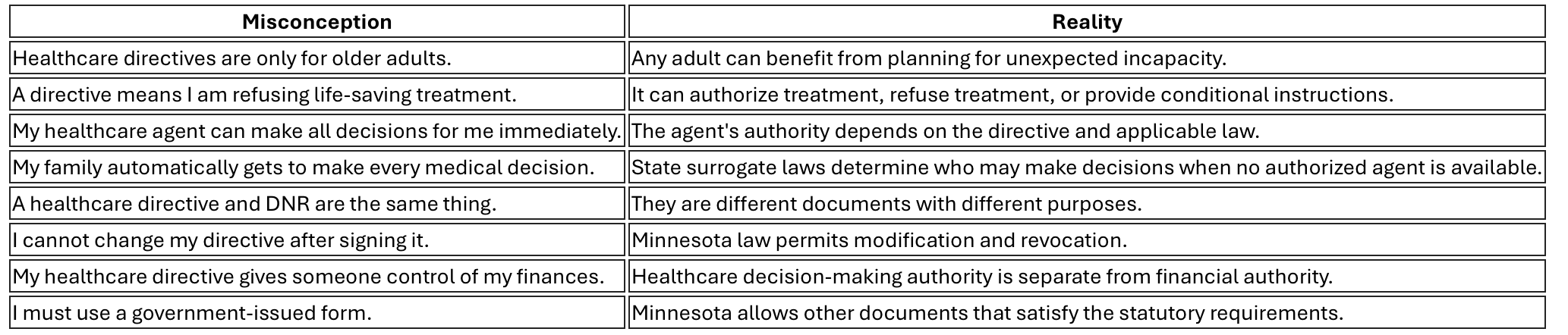
Why everyone should have a healthcare directive
Healthcare directives are about maintaining control over personal medical decisions. They allow individuals to express their preferences while they are able to do so and help ensure that someone they trust can advocate for them if they become incapacitated. They also provide important benefits to family members by reducing uncertainty and helping loved ones understand what decisions should be made.
Without a directive, family members may be left struggling to determine what a person would have wanted during an already difficult medical situation.
Preparing a directive can help:
Preserve personal autonomy.
Reduce family disagreements.
Improve communication with healthcare providers.
Identify an authorized decision-maker.
Provide guidance about life-sustaining treatment.
Communicate personal values and preferences.
Reduce uncertainty during medical emergencies.
A healthcare directive is not simply an end-of-life document. It is a practical tool for protecting an individual's healthcare rights throughout adulthood. A properly prepared healthcare directive provides an opportunity to document personal values, identify a healthcare agent, and communicate preferences about medical treatment.
Although the process may seem uncomfortable, having these conversations before a crisis occurs can make an enormous difference for both individuals and their families.
The best time to prepare a healthcare directive is while you are healthy, informed, and able to make decisions independently.
Minnesota Statues and Government Resources
Minnesota Statutes § 145C.02 – Health Care Directive.
https://www.revisor.mn.gov/statutes/2026/cite/145C.02Minnesota Statutes § 145C.03 – Requirements for a Legally Sufficient Healthcare Directive.
https://www.revisor.mn.gov/statutes/2026/cite/145C.03Minnesota Statutes § 145C.05 – Suggested Form and Provisions That May Be Included.
https://www.revisor.mn.gov/statutes/2026/cite/145C.05Minnesota Statutes, Chapter 145C – Health Care Directives.
https://www.revisor.mn.gov/statutes/2026/cite/145CMinnesota Department of Health – Health Care Directives Questions and Answers.
https://www.health.mn.gov/facilities/regulation/hcdirectives.htmlMinnesota Attorney General – Probate and Planning Handbook.
https://www.ag.state.mn.us/brochures/pubprobateandplanning.pdf
Federal and National Resources
National Institute on Aging – Advance Care Planning: Advance Directives for Health Care.
https://www.nia.nih.gov/health/advance-care-planning-advance-directives-health-carePatient Self-Determination Act – 42 U.S.C. § 1395cc(f).
https://www.law.cornell.edu/uscode/text/42/1395ccHealth Resources and Services Administration – Organ Donation.
https://www.organdonor.gov/
Disclaimer — This three-part blog series is provided for general educational and informational purposes only. It is not legal advice, medical advice, or a substitute for consultation with a qualified attorney or healthcare professional.
Healthcare directive requirements differ among states and may change as laws are amended. The Minnesota-specific information in this article is based primarily on Minnesota Statutes, Chapter 145C, and Minnesota Department of Health guidance available as of November 11, 2026.
Individuals should review the laws applicable to their state and consult an attorney when questions arise concerning legal capacity, execution requirements, healthcare agent authority, pregnancy-related provisions, mental healthcare instructions, or other specialized circumstances.